Friday, 21 December 2007

The Millisecond Men Part 7: Time Waits For One Man

I know it's been a while, but here is the conclusion to THE MILLISECOND MEN, my little act of improv sci-fi writing.
THE MILLISECOND MEN
Part 7: Time Waits For One Man
by
D.R. MacMaster

"You know where the Stone of Time is?" asked Quo Vida.


"Yes," answered Bob. "It's at the old make-out spot about a half mile east of here."

"Hmmm," said Quid Civitas, the ghost in the alien's machine, "But the Treskarians went west."

"It could be some sort of distortion in their temporal scanning devices," said Quo Vida.

"Or they could be just stupid," said Bob. "Let's take advantage of the situation and save the universe."

"I'll wait here," said Quid Civitas, "what with me being dead and all."

"Let's go," said Quo Vida to Bob, but then she paused and turned to the hologram of her dead colleague. "And when this is done, I'm going to go back in time and kick some sense into your head when you were alive and stop you from starting this mess."

***

"Can you do that?" asked Bob as he and Quo Vida ran across the high school's football field. Since everything and everyone around them had been frozen in time and space, he wasn't really bothered anymore by being out in public in his pajamas and housecoat.

"Do what?" asked Quo Vida, running a good clip despite her impractical looking purple high-heeled boots.

"Go back in time and prevent this from happening?"

"That's what Quantum Agents do," said Quo Vida. "Though we are only allowed to directly interfere when someone, like the Treskarians, tamper with the timeline."

"Cool," said Bob.

"Where's the Stone of Time?" asked Quo Vida.

"Over there," said Bob, "behind the bleachers."

The pair ran around the bleachers until the both stood before a massive slab of stone.

Quo Vida took out her Does-All and scanned the edifice.

"This is it," said Quo Vida, "it's the stone of time... oh?"

"What's the 'oh' for?"

"I now know why you weren't frozen in time like everyone else," said Quo Vida.

"I'm full of tachyons," said Bob resting his hand on the ancient stone, "you explained that."

"But I couldn't explain why you're full of tachyons," replied Quo Vida. "Now I can."

"Why?"

"You were conceived on this rock," said Quo Vida, pocketing her Does-All. Bob retracted his hand.

"One word," said Bob, "eeeewww."

"Well," said Quo Vida, "there's only one thing we can do to set everything right. We have to destroy it."

Bob drew the Treskarian pistol. "I guess it's good that I brought this."

"Threeble!" screamed a high pitched voice behind them.

Bob and Quo Vida spun around to see the remaining Treskarians, weapons drawn, staring at them with their blank masked faces. The center Treskarian was holding some sort of glowing staff in his hand.

"Oh crap," said Bob, pulling the trigger on the strange looking weapon.

It was then he realized that he was holding it wrong again.

A brilliant orange flash went right by his head and struck the Stone of Time directly in the center. There wasn't a roar of destruction, but rather a strangely anti-climactic popping sound. Then a ring of white light shot out from the stone.

The Treskarians collapsed, first their flesh and bones turned to ancient dust, then their spacesuits began to rust and crumble.

"What's happening?" asked Bob.

"The time stream is going back to normal," said Quo Vida, "you did it. You saved the universe."

"I got to get home," said Bob.

***

Bob shook the dust from the alien vessel, now decayed into a flaky green dust, of his father's shotgun and put it back in the closet. Although things still looked frozen to him, time was passing, and quickly for some people.

By the time they returned to the Treskarian ship, it was a pile of rust and the alien that once menaced them was now only dust. Only the shotgun remained unchanged.

Bob ran to the kitchen, pulled a cup from the shelf and crouched down beside the blob of coffee that still hung in the air, though a millimeter lower than when he left it.

"One...two... three..." said Bob, and the coffee splashed into the cup.

The sound of cars passing outside, and the shower running upstairs returned.

Time, and the universe were now safe, thanks to Bob.

Bob took a swig of coffee. It all seemed like a strange dream now, and with the passing of just a second, all trace of the alien attack, and his heroism vanished.

Footsteps came down the stairs.

"Is the coffee ready honey?" asked Jennifer, in her bathrobe.

"Yep," said Bob, pouring her a cup.

"What's that in your pocket?" asked Jennifer.

Bob looked down, sticking out of his housecoat pocket was the Treskarian pistol. It was then that he realized that it had somehow survived the transition, probably due to that tachyon thing Quo Vida talked about.

"This?" said Bob. "Well, it's a bit of a peculiar story..."

THE END

Thursday, 20 December 2007

Hollywood Babble On & On... #16: Sympathy for the Devil's Advocate

Hat tip to Nikki Finke who posted this story about how the Alliance of Motion Picture & TV Producers (AMPTP) declined participating in hearings held by the Los Angeles City Council about the economic impact of the Writer's Strike on the LA economy.

Instead the Motion Picture Association of America (MPAA) their chief lobbying body submitted a statement into the record, but refused to testify or answer any questions.

Now before Variety's Peter Bart accuses me of having "drunk the Kool-Aid" and becoming a shill for the sinister "organizers" of the WGA, (as if he would read this blog) I will say that the AMPTP could
argue, that since the MPAA was best equipped to handle the hearing because it represents the same people and is designed for and experienced in dealing with municipal, state and federal governments.

But, and it's a big but...

The MPAA didn't handle the hearing. It merely had a rep submit a statement into the record.


Hearings are about testimony. Testimony is about people presenting their case before the governing body, God, and the American public.

Submitting a dry statement conceived by public relations firms that lack the sense to put a lock on the .com address for their website is not testimony, and it is not going to win any friends or influence people.

At least not anyone who doesn't live in Beverly Hills or Malibu.

It amazes that the people who run an industry based upon image can't see the image that they're creating for themselves.

The only way they could have handled that meeting any worse was if AMPTP honcho Nick Counter showed up dressed like Snidely Whiplash and declaring, whilst twirling his waxed mustaches, that once they crushed the writers they were going to get the widows and orphans next.

They could have let the MPAA handle the hearing, but like I said, they didn't try to handle it.

And that's a sign of incredible weakness and contempt, the chief poison in the apple of Hollywood.


Weakness because the moguls and their spin doctors lacked the imagination and will to handle it. Public hearings are all about making a case, and if you don't have a case other than your own contempt and greed, you need more spin than a top balanced on a centrifuge.

But the AMPTP/MPAA didn't even
try to spin their way through the hearings.

It can't be because they are concerned about what people think of them. The majority of Americans think they're jerks. Spinning like one wouldn't have dug that hole any deeper. In fact, there's a slim chance it might even help, but that requires imagination, intelligence, hard work, and most of all, a sense of respect for your opposition and the general public.

But they don't have that. Instead they have contempt.

What else other than contempt would compel the moguls, people in the business of telling and selling stories, to believe that they don't need stories as long as they have equity investment from Dubai and European Union tax shelters
to keep them afloat.

What they don't seem to realize is that those investments and shelters are worthless without stories to tell and sell, that this strike, which could spread to include actors and directors, could cripple, if not destroy, the industry, and that in this destruction they are casting themselves as the villain.

And pretty lousy villains as it is.

One of the fundamental truths about good storytelling is that the villain, no matter how evil their deeds, must believe that what he/she does is right, even if it's only for the fulfillment of their own wants and desires.

The AMPTP is acting like the villain, but not
a modern sophisticated well rounded villain, with depth, intelligence, and the ability to at least make a case for their villainy, but a old fashioned cartoon villain who does villainous things just because they think it's what they should do with no logical rationale behind it.

It's also a tactical error. No tactician would suggest not trying to make a case for being right, no matter how wretched, without some sort of grievous head injury. Even if your arguments are all wrong and based on a foundation of lies and greed, at least you tried, and that might actually convince some people. (It happens in politics all the time)

And it's not an impossible rhetorical exercise. In fact, it's a centuries old tradition.

In the old days, when the Vatican was deciding on the canonization of a saint, no matter how holy and pure the person in question was, there was a man appointed to be The Devil's Advocate. It was his job to argue against sainthood, and to compose believable and intelligent arguments for that argument, even if the person personally didn't believe any of it.

And even though they may have disagreed with the presentation they were making, they were intellectually honest enough to admit that the argument was necessary, if not to themselves, but to the search for truth.

Now the AMPTP/MPAA have apparently given up on playing their own Devil's Advocate and the only explanation for not even trying is that they hold anyone who is not a fellow mogul in too much contempt to even lie to their faces about the issues at hand.

People can understand being greedy, and they can understand spinning, and even lying, but they don't like being looked on as unworthy of being included in the discussion.

Of course if Hollywood's moguls weren't crippled
with contempt their industry would be in a lot better financial shape than it is now.

That's why I'm continuing my ongoing campaign to replace Robert Shaye as head of New Line Pictures.

I even have a catchy poster, and image is everything you know...


Wednesday, 19 December 2007

They've Convinced Me...

I now think the AMPTP is right about everything. Just look at this video that explains their position...


Wow.

Now I know all those WGA strikers are all Communist radicals instead of hard-working creative people who just want their fair share of some enormous profits.

Tuesday, 18 December 2007

Hollywood Babble On & On... #15: The Happy Hobbits of Hollywood...

A big hat tip to Hollywood source Nikki Finke for the story about Bob Shaye, my rival for the position of CEO of New Line, making a settlement with LOTR auteur Peter Jackson for him to executive produce The Hobbit which New Line and MGM will co-finance.

So, what does it really mean, aside from a new line of cosplayers at every comic book and fantasy convention after the films are made?

Well, it's an obvious ploy by Robert Shaye to save his own hide.

He's hoping that this 'all is forgiven' attitude will extend to the New Line shareholders who are increasingly unhappy with his dysfunctional management style that managed to alienate filmmakers and audiences alike.

But will the board of New Line forgive and forget and renew his contract?

Only if they forget that Shaye started the feud with Jackson, delaying the continuation of a so far $3 billion+ franchise by years.

Only if they fail to notice that The Hobbit will cost the company mega-millions before a single frame is shot just to settle a massive lawsuit with the executive producer instead of just paying what was owed, when it was owed, which was a time when the company was more flush with cash and assets. (You know it has to be huge money considering the often childish bad blood Shaye created with Jackson that kept the feud going way longer than it should have and the original suit was for something like $100+ million.)

Only if they forget that Jackson was just one of many money-making filmmakers that Shaye drove away from the company with a mix of greed, contempt, and verbal vitriol.

Only if they forget the debacle of opening a $250+ million film (The Golden Compass) that presented religious people (especially Christians) as the villains at the beginning of CHRISTMAS TIME, which despite the company's spin will fail to turn a profit despite middling to good overseas box-office. (This is because New Line doesn't distribute outside the USA, leaving approx. 60% of box-office revenue in the hands of foreign distributors depending on their arrangement with New Line)

And there you have it.

It should take more than just a hug and an on paper deal to save Shaye's hide, in fact it's the studio management equivalent of putting one of those car air fresheners in a fertilizer factory. It's just a little hint of pine in a sea of shit.

That's why I'm keeping my name in as his potential replacement.

I think my campaign slogan says it all...

FURIOUS D... HE CAN'T BE ANY WORSE

PS: I'm starting a pool where people can post their predictions of how long it will be before Shaye screws up The Hobbit deal.

I predict that he will drive away Jackson from The Hobbit within 48 hours of getting his contract renewed. (Taking into account the time zone differences between LA and New Zealand)

What do you think?

Monday, 17 December 2007

Hollywood Babble On & On... #14: A System for Idiocy

There's a term I've used a lot over the years, and some of my friends have used it too. (without giving me any credit, but I'm not bitter)

The term is: The Self-Fulfilling Idiocy.

It's sort of like a self-fulfilling prophecy, but it has more to do with stupid actions creating more stupid actions until everything goes totally ape-feces in your face.

Now the classic self-fulfilling idiocy is what's happening in Hollywood.

But before that, a little history.

In the very dawn of cinema, actors didn't get any credit at all. In fact, the leading female actress of the Biograph company was simply known as The Biograph Girl.

However, that situation didn't last long.

We are talking about about actors here, and there's nothing they like more than seeing their name written in very big letters.

So during the Silent Era of the 19teens and 1920s two systems rapidly emerged: The Studio System and the Star System.

The Studio System boiled filmmaking down to factory like efficiency, because each studio had to produce at least one to two new films a week to show in the theatres they owned to stay afloat.

The Star System was where each studio had a stable of 'stars.' Actors whose talent, charisma, and public persona could help sell a film to the general public.

These actors were usually signed to 7 year contracts that meant that pictures were assigned to them by the studio, not picked by themselves. Those that disobeyed the studio got suspended, or even blacklisted as 'difficult.'

This system of gilded servitude lasted throughout the 1930s and 1940s as a form of symbiosis. The studio needed the stars to sell their films and the stars needed the studios to pay them, protect them, and provide work.

But then things started to change. First came World War 2 with many top names going overseas to fight fascism, second came the consent decree.

The Consent Decree was a move by the US federal government that meant that studios could no longer own the theaters that showed their films, because it constituted a form of monopoly.

Then the actors who served in the war decided that they weren't going to take the studios crap anymore and demanded greater independence. Some even becoming producers of their own films.

Then came TV.

Suddenly the studio system's monopoly on entertainment was on the wane. Many companies skirted bankruptcy, and most of the smaller studios collapsed. The old style moguls who built the business were forced out, and many studios were taken over by big multinational conglomerates. Suddenly Paramount became just another corporate subsidiary, logged in the books right next to the division that made widgets.

Hollywood flailed around during the 50s and 60s, trying to recapture lost glory with massive screens and grand technicolor extravaganzas.

Most of these projects failed.

The power of 'big stars' to demand big money also waned. Thus you started to see in the 60s and 70s big names appearing in grand epics one week, low budget foreign made schlock the next.

Then came the movie brats.

They were a generation of filmmakers raised on Hollywood classics and brought into the business through Roger Corman's low budget exploitation factories at American International and New World Pictures suddenly found themselves at the top of the cinematic food chain.

They made movies that the public wanted to see, and the normally closed shop of Hollywood suddenly blew wide open.

This led to a wave of creativity unseen since the emergence of the 'talkie' in the late 20s.

It also led to what I call the 2nd Star System.

This time it was the stars who called the shots.

They wanted control over their projects, big money, and a piece of the profits.

The studios, desperate for a piece of the success they promised, agreed.

Now this is where the self-fulfilling idiocy begins.

By the time of the 1980s the directors and stars that made their name in 70s were getting fat on big money from big movies.

The studios became a closed shop once again, no new talent or skilled tradespeople welcome. (Except for a brief moment in the early 90s during the 'indie-Sundance-boom but that's another story)

These developments led to movies becoming more and more expensive.

To protect their investments the studios started playing with the books, so suddenly profits began to disappear. Huge blockbusters were mysteriously written off as money losers, because they had less successful films attached to their budgets.

Suddenly the big names decided that having a piece of the profits wasn't enough if there weren't going to be any profits. They wanted big money up front, and a piece of the gross revenue, from the first ticket sold to the last VHS tape rented.

Production costs went even higher.

Then the 90s brought in what I call the Super-Agent System.

A select few elite agencies got control of all the top star actor and directors. If you wanted that star to be in or to direct your studio's movie, you not only had to pony up the big money, but you also had to hire some of the agent's other clients for big money. 10% doesn't grow on trees.

This was called 'packaging.'

But even that time came to pass. Especially when some of these 'super-agents' became heads of studios, and realized that they weren't super managers as well.

However it left Hollywood crawling with actors and directors who are on the so-called 'A-List' because their agents got them big money on the coat-tails of their more successful clients.

This system was maintained by a new system, what I call the Publicist System.

The 80s and 90s saw an explosion in celebrity driven media, from tabloid newspapers, magazines, and TV shows. These outlets needed a steady stream of 'stars' to populate the gaps between ads for zit cream and time-share opportunities in Boca Raton.

To get the 'A-list' actors, they had to appease their publicists, which meant that they not only had to treat their top clients with kid gloves, barring anything short of a murder charge, they also had to treat their less famous clients as if they were big stars as well.

So you had the media appeasing the publicists promoting actors beyond their star-power, so their agents could demand big money and pieces of the gross revenue.

This causes costs to go way up beyond inflation, despite new technology, revenue to go down in the real world, and not just on paper, and everyone except the select few at the very top, getting the shaft.

So to boil it all down, the studios, being greedy, started denying that films made money. This led to more up-front costs, and pieces being taken from the back end gross revenue.

Thus ensuring that films don't make any real money, no matter what the box-office take. And even though it's killing them, the studios are still being greedy, and still trying to screw everyone instead of reforming and simplifying the system.

And that is what I call a self-fulfilling idiocy.

Sunday, 16 December 2007

Hollywood Babble On & On... #13: The Fresh Prince of the Box Office

Will Smith is one of Hollywood's last true movie stars.

He might very well be the only actor in Hollywood that can be considered "bankable." Especially now since his sci-fi/horror flick I Am Legend has broken the record for a December film opening.

Now many are wondering why his movies are usually profitable when so many others on Hollywood's 'A-List' couldn't fill a theater if it was the only place on Earth safe from a rampaging horde of poo-flinging, blood drinking, brain-eating
vampire-zombie monkeys.

I can answer that.

The audience trusts him and Will Smith trusts the audience.

Will Smith knows that his fortunes ride on the good-will of the American public, not on the whims of fashion as dictated by Hollywood's select few, or the by who the paparazzi stalk the most.

He lives outside the epicenter of the Hollywood frenzy, and only appears for the paparazzi at premieres, charity events, and award shows. You don't see him in the tabloids, cocaine caked on his nose, being dragged out of his mansion by police. In fact, he makes a point to have a personal life that, despite his wealth, is as boringly normal as everyone else.

This aura of normalcy, combined with his easygoing charm, and his talent as an actor, allow him to connect with the audience on an emotional level.

Plus there's also his careful selection of projects.

Most 'A-List' stars base their decisions on ego, money, and acceptance by their Hollywood neighbours. But what your ego, banker, and your Hollywood-type neighbours want to see are not what the average American wants to see.

Will Smith's choices are based on what he thinks the audience wants to see, primarily what he would pay money to see if he was an average middle class American.

They want a good guy who fights bad guys, action (it is called the Motion Picture for a reason) thrills, chills, and some humour. They don't want to see boring, repetitive tales of suburban angst that have more to do with life in Beverly Hills than the average suburb. They don't want to see films where they are insulted through 1 dimensional caricature for being religious, patriotic, or not being as fashionable as the folks in Malibu.

Plus they know that Will Smith works hard at his job. He doesn't blow off work to go party and drive drunk. He's an entertainer and he knows that it is his job to entertain the general public, and that it is a job that he has to do to the best of his ability in order to stay on top of the food chain.

The audience knows that on an emotional level, and they respect it.

And that's why he's one of the last movie stars in Hollywood.
"What did you say Lassie? Hollywood's profits have fallen down a well?"

I can beat large numbers of children! Hooray!

36

Thursday, 13 December 2007

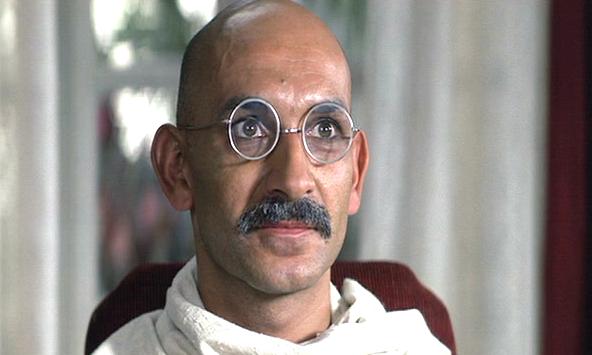
Hollywood Babble On & On... #12: Gandhi, Oscar, & Making the Audience Your Enemy

Last night I was reading My Indecision Is Final: The Rise and Fall of Goldcrest Films... by Goldcrest founder Jake Eberts and business journalist Terry Illiot. Specifically I was reading the chapter on the making and selling of the Richard Attenborough's epic bio-pic Gandhi to Hollywood and the American public, and it shows how much Hollywood has changed since the early 1980s.

But first, a little background.

Goldcrest Films was started as a film finance fund by Canadian Jake Eberts and a partnership with British conglomerate Pearson-Longman. It rapidly grew to become a major independent player, dominating the Academy Awards in the early 1980s, and produced a series of modestly budgeted, intelligent, mature, and ultimately profitable films.

Sadly Eberts left the company for a better paying job, turf battles arose among various factions in the company, it got over-extended when it tried to out-epic Hollywood, and soon collapsed.

But that's another story.

What I want to talk about is the film Gandhi.

For years actor/director Richard 'Dickie' Attenborough had fought to bring the life and work of Indian leader Mahatma Gandhi to the big screen. After decades of struggle he convinced Goldcrest, the Indian government
and other investors to put up $24 million* dollars to make the epic.

After the film was made, on schedule, and under budget, Goldcrest then tried to sell it to Hollywood.

Fox was interested at first, and their executives
praised the film, but the passed. They didn't think the film was 'commercial' enough for the American audience.

Goldcrest then went to Columbia Pictures with Gandhi.

They loved it.

Then Columbia did something shocking.

They bought it.

They accepted that selling the film was a challenge, it was about a topic they weren't familiar with (the independence of India from British rule), set in a country the average American wasn't familiar with (India) and starred a then unknown stage actor named Ben Kingsley as Gandhi.

But they took that challenge not as a minus, but a plus.

They carefully marketed the film in a way to make the audience want to see because it promised not only spectacle and drama, but taught them something new, not only about the history of India, but about the human condition in general.

Elements of the human condition that the audience could relate to on an emotional level.

It showed that despite the cultural differences on the surface, the average American, and the average Indian held many of the same things in common.

The film was marketed not only on this universal emotional connection, but also to make the audience feel smart by going to see it. You may never go poor underestimating public taste, but if you can make them feel better about themselves, you will be pleasantly surprised by their good taste.

The audience came to Gandhi, felt that connection, felt smarter and better about themselves which helped them enjoy the film, and they repaid the film with excellent word of mouth.

The film then went on to be one of the major box-office hits of the year, win Oscars for just about everyone nominated, and then landed $20 million dollars, a then unheard of price for an independent production, for the US television rights from Embassy Pictures, who then sold it to HBO for $23 million.

Everyone involved enjoyed both critical and commercial success.

Now what would happen if Gandhi was made today?

Nothing.

A studio wouldn't make it today.

They'd take one look at the script and not see the universal themes that would appeal to the average American, but only a skinny Hindu in glasses doing a hunger strike for freedom where the average Hollywood starlet does it for magazine covers.

Besides, marketing such a film takes actual work and imagination, two things that seem to be avoided like death in Hollywood these days.

So instead of doing actual work to find out what connects with the average moviegoer, Hollywood has shifted to what they think is supposed to be challenging.

So you end up with:
  • Whiny tales of suburban sexual ennui, that claim to challenge conventional mores, but really only serve out the same cliches as the last film about suburban sexual ennui.
  • Boring, one-sided political lectures that present the side Hollywood opposes as cartoonish bloodthirsty villains, dimwitted buffoons, or both.
  • Outright condemnations or insults directed at the religion of the average moviegoer by presenting them as inherently evil, stupid, and/or hypocritical.
These aren't challenges to moviegoer to learn and expand. A challenge presents an honestly felt belief through a serious and intelligent argument. Intelligent and serious arguments require work and serious thought.

These sorts of films are not based on serious thought, but a rather cynical ploy to appeal to Hollywood's elite inner circle by presenting what they think is challenging.

The audience votes with its wallets, and most of these 'challenging' films end up circling the bowl financially. Yet they end up dominating the awards that Hollywood loves to give to itself, because they think they have to honour them because it presents what they think they have to believe in to be true artistes.

So Hollywood keeps making movies that lose money, and poison the art of film-making confident in their belief that they're doing the right thing, because they keep praising themselves for doing it. They start to think that these films fail because the audience, the great unwashed in flyover country, must be wrong, stupid, bigoted, and the enemy of quality.

Thus creates what I call a self-fulfilling idiocy.

Mainstream films get dumber and dumber with more attention and money paid to create CG effects and .

The majority fail to make a profit, because they don't connect emotionally with the audience, and only offer empty spectacle, but when some do hit it big, the studio suits think it only confirms their theory of audience stupidity and keep their fingers on the dumb button.

And more 'artistic,' 'serious' films, or 'independent' films (produced and/or released by major studio subsidiaries) aren't geared towards the general population anymore, but more to appeal to various and sundry political, social, and sexual fetishes of Hollywood's elite.

So you see the Academy Awards honouring more and more films that fewer and fewer people see. Critics scolding the general public for not spending their hard earned dollars on seeing a film that the critic only gave a thumbs up to because he felt he had to in order to get invited to all the good parties.

Box office suffers, the quality of films suffer, and culture and general suffers.

And then it all ends.

Not with a bang.

But with a silent theatre.


*I was stunned to see that budget figure.
That wouldn't pay for J-Lo's dressing room furniture these days.

Monday, 10 December 2007

Hollywood Babble On & On... #11: 7 Kinds of Stupid

This is the real AMPTP web site that offers their side of the Writer's Strike.

This is a spoof of the AMPTP web site, probably organized by some writers with too much time on your hands. (h/t Nikki Finke)

Now what do these two sites tell you?

And I'm not talking about how producer's site somehow makes dishwater look exciting.

I'm talking about how the AMPTP, and via them, all of Hollywood management thinks.

Still don't get it?

Okay, I'll explain it, slowly, so even a Hollywood executive can figure it out.

The mere existence of a spoof site, using the .com address shows that the AMPTP's membership and management possess a mix of contempt, arrogance, and stupidity.

I've discussed contempt before. So I'm going to stick to arrogance and stupidity tonight.

Now .com is the most common address on the internet. It is just about everywhere. In fact many people type .com simply out of reflex, even though they intend to go to .org, .net or whatever...

So it's natural for any organization to buy the .com address for their site, even if they intend it to be something else. It's basic common sense to prevent fraud-artists, pornographers, and parodists from using an address similar to your and getting to visiting them instead of you.

However, common sense seems to be lacking in Hollywood.

The brainiacs of the AMPTP who secured the .org address without securing the .com address probably didn't think that they would be parodied. They lacked the foresight, or even the basic imagination to realize that they're up against people who use their imagination for a living, and that a large number of those people write comedy.

They are arrogant enough to think that they're dealing with people as uncreative and narrow minded as they are. Underestimating their enemy is one of many mistakes.

Of course they probably are also blind to the fact that the people who use their imaginations to make a living, are also key to the AMPTP members making a living too.

The AMPTP has had it too good for too long. Hollywood's been the dominant supplier of entertainment for almost a century, and that dominance has made it smug and stupid.

Smug in the fact that it assumes that it will always be the world's #1 source for entertainment, and that those who actually create that entertainment will have to do their bidding and call it ice cream, because they think they will forever be the only game in town.

Stupid in the fact that while technology should make production cheaper and more efficient, costs are going up beyond the rate of inflation. Yet other countries are using this new technology to produce entertainment that catching up with Hollywood in production values without the expense.

Of course I'm talking about companies that dole out massive bonuses to executives whether the company profits or not.

Which goes beyond stupid and arrogant into the realm of either corruption or insanity.

To save itself the AMPTP has to trim the fat, starting with the clotting wads that lie between their ears. They must shake off old inefficient methods, streamline the executive suite, and realize that their main business is the telling and selling of stories, everything else is just icing on the cake.

That's why I'm campaigning to replace Robert Shaye as head of New Line. Sure, I don't know what I'm doing, but neither does anyone else in Hollywood.

But at least I know that I don't know what I'm doing.

That makes me overqualified.

Furious D's Hollywood Dictionary: B is for....

Here's part 2 of my Hollywood dictionary. If you have any suggestions, drop me a line.

B.

B-LIST:

1. A mythical list of actors whose specialty was at starring in low-budget films designed to appeal to kids, teens and fill out the 'B' section of a double bill.

2. A mythical list of actors who have to work for a living.

BANKABLE:

1. What the A-List used to be.

2. What the A-List ain't no more.

BLOCKBUSTER:

1. A film that makes more than a profit, but a mega-profit.

2. A film that went overboard on FX and marketing, that might make a profit if it's really luck.

BOX OFFICE:

1. The life's blood of Old Hollywood. It was the money earned by a movie through ticket sales.

2. The least important factor in determining if any film gets a green-light these days.

BUTTON PUSHING:

1. Challenging people's preconceptions about a controversial subject through art, that presents a thesis and antithesis blended to present the artist's personal view.

2. Pretending to be a courageous artist by making material that's condescending, derogatory, or downright insulting to any group least likely to respond with legal action or outright violence.

BUZZ:

1. Word of mouth among the general public about the quality and appeal of a particular film.

2. Word of mouth among a select group of elite media figures.