Monday, 11 August 2014

The Book Report: State of an Industry...

Some have noted that in recent posts about the book industry that may come off as a tad anti-Amazon. Well, I'm a tad anti-dysfunction, and Amazon has recently been the biggest, pushiest, and loudest part of a very dysfunctional industry.  So let's take a look at the industry as a whole.


AMAZON

They're biggest problem is that they want to be more than just the best place to get a book or e-book, they want to be the ONLY place to get a book or e-book.  

They're racking up big losses on the road to monopoly-land so they're picking fights with publishers, authors, and even Disney to take on some of Amazon's losses for them. While some think nationalizing it is the key, I think some actual competition might be just what the business needs.

The feud between Amazon and publishers is preventing the market from reaching a natural price point for e-books.


BIG FIVE PUBLISHERS

The Big Five used to be the Big 6 before merger mania put Penguin and Random House together.

Where to begin?

The industry acts less like an industry and more like a gentleman's club from the 1900s than a real industry. Everything's all very polite, and no one would dare compete too aggressively with a fellow club member.

It's also resistant to change, having been dragged kicking and screaming by market realities into paperbacks, and now into e-books. Even though e-books are a great way to get their mid-list titles moving at a very low cost, they spend more time and effort trying to figure out ways to sink it, than to exploit it. I'm talking about complex DRM, prohibitive pricing, and now Scholastic is thinking of a new "streaming subscription" model where you pay for e-books, but don't actually own them.

Now you might wonder what I mean by "mid-list" titles. Well, those are books written by authors who are not big New York Times best-seller list superstars, or celebrities. They usually write the genre fiction that stocks the shelves and keeps readers entertained, and are the bread and butter of the industry, but many find it harder to make a living now than ever before because whenever the Big Five have any sort of setback or problem, they slash their mid-lists, either by reducing advances to less than minimum wage standards, or just dropping authors completely.

Although they deny it, I suspect that one of the problems that afflict the biggest publishers is that the celebrity based books that land their "authors" massive advances don't sell as well as the Big Five like to claim they do. Take for example the essay collection Not That Kind of Girl by Lena Dunham the creator/star of HBO's Girls. She got a $3.7 million advance on the basis of her celebrity.

But is she really a celebrity?

She gets a lot of hype within the New York centric media, but her show struggles to find more than 500,000 viewers, which even by today's fractured viewing standards counts as a flop. Also her attempts to present herself as a "Jane Average" speaking for the "average girls" sound like the female equivalent of Thurston Howell III trying to make friends in a working class tavern in Akron, by pretending to be "one of them." 

Then there's the big money deals for "novels" "written" by Jersey Shore humanoid stain Snooki, whose fans were either illiterate, or watched the show simply for the schadenfreude of saying "look at those lower order buffoons" but who wouldn't be caught dead spending money on her book.

The Big Five would defend themselves saying "Those were good investments, look at the Best-Seller lists!" Well, I'll get to the problems with the Best-Seller lists momentarily, but let's just say we can't really trust them. What I would like to see is a thorough neutral 3rd party audit that reveals how many of these big money celebrity-author deals, which are made by the dozens every year, actually make money. Then maybe the Big Five might learn to be more discriminating with who they make these sorts of deals with, and how much they spend.


NON-AMAZON BOOKSELLERS

Amazon is more than just a retailer, it also has a division that publishes books and e-books, and has actively recruited mid-list authors who were being dropped or being screwed over the Big Five. However, try to get one of these books at your neighbourhood bookstore, and you're out of luck.

That's because many of the big retail chains and distributors have refused to carry anything released by Amazon's publishing imprints.

But wait, there's more…

Many authors, including some major best-sellers, have deals adapting their work as movies or television series for release on Amazon's video service. They're not boycotted, because they're big sellers signed to big publishers, so there's a wee bit of a double standard there.

I think such a business practice is being used by Amazon to justify some of their own antics. Which creates a seemingly unending cycle of stupid where the biggest victims are the mid-list writers signed to Amazon publishing who can't get their books in stores.

Also, try to order a book at a bookstore, even a major chain, and you will have to wait weeks to get what you want. That's no way to compete with Amazon. That's why I relentlessly advocate the publishers and the booksellers work together at adopting the latest print-on-demand technology to make any book available at every bookstore within a matter of minutes.

SALES METRICS

I mentioned earlier that we can't trust the measurements that tell us what is really a best-seller and what isn't. The premiere list is the New York Times Best-Seller List, and it has a dirty little secret, in fact, the whole thing is a secret, and may have very little to do with people actually buying books.

You see the algorithm is a trade secret of the New York Times, supposedly to prevent anyone from manipulating it. However, it can be, and has been manipulated.

The most obvious case involves the novel I, Libertine by Frederick R. Ewing, a saucy adventure set in Georgian England. It made the NYT best-seller list in 1956 even though it did not exist. It was a creation by radio raconteur and author Jean Shepherd who was unhappy with how the list was managed, and decided to game the system by asking his listeners to order a book that didn't exist. He made up the title, a fictional author, and some plot points in case anyone asked for more detail.

It worked, it made it onto the best-seller list, and Ballantine Books even made a deal with Shepherd to have Theodore Sturgeon write a real version of the book, that too made it to the best-seller list.

You don't think publishers know how to game the system by now?


SELF-PUBLISHING

Publishing your own books may seem like a great idea. Hell, I've done it myself, but guess what, the odds of finding an audience are infinitesimal than if you had a more traditional publisher.

It's next to impossible to be found among the hoards of amateur dinosaur erotica, or set yourself apart from the tens of thousands of wannabes who just slap up their first draft with some eye-bleedingly bad cover-art in the hopes that they'll be the next big discovery.

Traditional publishers offer editors, marketing, and the unmentioned notion that someone separated this bit of wheat from the reams of unreadable chaff. Selling in any serious amount as a self-published author requires a level of luck found only among lottery winners.

That's what I think, feel free to tell me what you think.

Saturday, 9 August 2014

The Book Report: Just Who Is Uniting Here?


Amazon has sent out an e-mail to just about everyone on the planet, and also opened a website called READERS UNITED, which they're using to declare themselves as the defender of the little guy against big meanie Hachette, and that all they want is to bring down the price of e-books.


Amazon makes some valid points.

1. E-books should be cheaper than a hardcover since they don't involve manufacturing a physical product, simply formatting an already digitized file and storing it on servers with literally billions of other books.

2. The publishing industry, especially among the Big 5, are slow to appreciate that e-books should be cheaper. The irony is that they don't need to engage in active illegal collusion on the matter, since the top echelons of the Big 5 have a long history of being resistant to change, and a reputation for moving like a herd without having to collude over anything. They treat publishing as a gentleman's club, sans strippers, and act accordingly, refusing to rock the boat.

However, is Amazon really the champion of the little guy in this fight?

Not really.

You see Amazon wants a monopoly on the book business, plain and simple. When you want a book, they want you to go to them and only them.

That's not healthy.

Not for publishers.

Now for writers.

Not for readers.


And actually not for Amazon in the long run.

This is because monopolies follow a pattern: Growth, Power, Decay, then Collapse with some government bailouts in between. The wannabe Monopolists can't avoid this pattern, but they hope to be long retired to their billionaire mega-mansions before the monopoly they created hits the Decay stage.


Building a monopoly is also damaging in the short run. To crush their competition Amazon is using their status as a major bulk retailer to slash their prices to levels no one else can match.


The problem is that Amazon can't match these prices either, and are racking up massive losses that they can't keep up doing forever. They need someone else to start losing money too, and they hope the publishers will go along with them.

Only Hachette isn't playing ball.

Now this is where I'm going to butt my know-it-all nose in.

The problem with e-book pricing is that they are not natural prices.

You see pricing is all about balance.

It's about finding that balance between what allows the manufacturers and retailers to profit, and the price the consumers are willing to pay.

Manufacturers like publishers, and retailers like Amazon, all have expenses. Publishers have to pay writers, editors, printers, technical staff, etc… and Amazon has to maintain offices, warehouses, and a massive tech-support staff. All those have to be included in the calculations when determining a price.

Then they have to include to average numbers of units they move, and how much consumers are willing to pay for what they're offering.

Go too high, and consumers will move on, charge too low, and you can't make payroll.

Amazon wants to go too low, but wants the publishers to suck up those losses so they can still make payroll. The publishers, like any business,  do not like losses, and use any sort of setback in business as an excuse to shit on the non-celebrity authors in their roster.

What both sides need to do is to step the fuck back and let a natural price form and use discounts for special offers and sales. That's what happened to the paperbacks that Amazon likes to cite, and they became a vital part of the business.

If they do let nature take its course they might find that everyone can be happy from the deal, publishers, writers, retailers, and readers.

So take a stand when buying e-books from Amazon and only buy all three of these e-books:

JOE AVERAGE - 2 Four-Star reviews for its mix of superhero action, satire, and even political intrigue.


MINDER - A complex thriller about a killer hired to stop other killers from committing a killing.


STUDIO NOTES FOR LITERARY CLASSICS - A cute little e-book that answers the question "What if the great works of literature had to deal with the meddling that goes into modern movies."

You can't blame me for a little shameless self-promotion.

I like money but never have enough of it.

Friday, 8 August 2014

Hollywood Babble On & On #1169: Comic Book Movie Cornucopia!

Both Marvel/Disney and DC/Warner Bros. have released their release schedule for a whole slew of comic book/superhero movies up until 2020, which by then we'll be ruled by giant alien robots.

I've astrally projected my mind into the future and I have brought back my predictions (10000% guaranteed) to tell you what the future holds:


DC COMICS/WARNER BROTHERS SCHEDULE:

March 25, 2016 – Batman V Superman: Dawn Of Justice 

Hoping to bring some of Batman's cool-factor with Superman's penchant for mega-spectacle, and open doors for other characters, and ultimately a Justice League movie franchise.

It makes a shit-ton of money, but so much was spent making and promoting it, it will fail to turn a profit.

August 5, 2016 – Untitled DC Film

The first release date for the Wonder Woman movie, which will be cancelled because the studio can't bring themselves to pull the trigger on a female led superhero franchise.

Replaced by a Green Lantern reboot which is a shot-for-shot remake of the failed Green Lantern movie, but this time Ryan Reynolds is replaced by Russell Brand.

It flops.

June 23, 2017 – Untitled DC Film

AQUAMAN! - starring Jonah Hill.

Flops, because no one really likes Aquaman.

November 17, 2017 – Untitled DC Film

Second cancelled attempt at a Wonder Woman movie. Replaced by a movie about LOBO, starring Mark Wahlberg, a character who was big in the 1990s, but no one gives a shit about anymore.

It flops.

March 23, 2018 – Untitled DC Film

SHAZAM!

But Dwayne Johnson was too expensive, and was replaced by Seth Rogen, with Justin Bieber as Billy Batson, who by this time is working for dime-bags of pot.

May 25, 2018 – Untitled Lego Movie

This movie will be even more egregious in the product placement because they think that's what people want, not realizing that audiences flocked to it because it was a family friendly all-encompassing parody movie.

July 27, 2018 – Untitled DC Film

3rd cancelled Wonder Woman release date.

Replaced with a Lobo reboot, this time starring Zac Efron.

November 16, 2018 – Untitled WB Event Film

Big money Justice League movie, but in the interim everyone introduced in the previous movies has been fired and replaced with cheaper actors.

April 5, 2019 – Untitled DC Film

Supposed to be Aquaman 2, but that flopped, so it was given to finally releasing a Wonder Woman movie, but then cancelled again.

Replaced by a Shazam reboot, this time starring Leonard DiCaprio as Shazam, directed by Martin Scorsese.

May 24, 2019 – Untitled Lego film

Reeling from the negative reaction to the all-product placement Lego movie this film is cancelled and replaced by a movie based on Oreo cookies.

It too flops.

June 14, 2019 – Untitled DC Film

Batman reboot starring Matt Damon.

April 3, 2020 – Untitled DC Film

Superman reboot starring Will Smith, who has recently ballooned to 300 lbs and refuses to lose weight.

June 19, 2020 – Untitled DC Film

Batman reboot starring Tobey Maguire. It replaces the cancelled Wonder Woman movie, this time starring Miley Cyrus. Film was cancelled in pre-production when Cyrus gets her flapping lizard tongue caught on a passing car that drags her all the way to Mexico.

November 20, 2020 – Untitled WB Event Film

Justice League reboot with a $500 million budget, an all black, all female cast, and all references to superpowers and super-villains replaced by discussions of relationships or long montage sequences about shopping. Naturally fans are baffled by a film marketed as a superhero movie turn out to be an unsanctioned remake of the first Sex & The City movie, causing Time-Warner CEO Jeff Zucker to go ballistic and threaten to sue everyone who doesn't buy a ticket to the movie.

No one buys a ticket.

Its failure is used as an excuse by Warner Bros. management to eliminate all female led films or ethnic diversity from its production slate.

MARCH 14, 2021 - Warner Bros. Purchased by News Corp.

After a string of expensive flops, an expensive lawsuit from Sex & The City's creator over the Justice League reboot, and Jeff Zucker's investing of all the corporation's assets into an all Rosie O'Donnell themed national daily newspaper, the whole Time Warner Empire, DC Comics included, goes bankrupt, and is purchased with the change in cyborg-Rupert Murdoch's couch cushions.

That's what's going to happen.

What do you think will happen?

Wednesday, 6 August 2014

Hollywood Babble On & On #1168: 3 Short Subjects

ROM-COM COMEBACK?

Romantic comedies used to be the backbone of Hollywood. This was true from the Golden Age to until fairly recently, and now the genre seems fairly moribund, but a columnist at Variety thinks it deserves a comeback.


Romantic comedies do serve a purpose. They make good "date movies" that both men and women can enjoy, and are a lot cheaper to make than the big epic action movies that dominate the summer box office, and used to be really common.

So why are they so rare now?

Variety thinks a major factor is that those who were major rom-com stars in the genre's most recent peak of the 1990s and early 2000s are aging out of the ingenue ranks, but that doesn't explain everything. The genre is cyclical, and suicidal.

Now let's look at what the hell I'm talking about:

CYCLICAL: Rom-Coms come and go in relation to wider social trends. In the 1930s the Screwball Comedies ruled both as a relief from the grimness of the Great Depression and as a satire of the tumult in sexual mores that occurred in the 1920s.

Over the decades the genre changed into different styles to reflect changing tastes. It fell into a bit of a stupor in the 1960s and 1970s because one of the key ingredients to a rom-com, consequences to romantic/sexual decisions, fell out of favour. 

In the late 1980s society was hungover from the sexual revolution, and people started to take relationships seriously again. This saw a return of the romantic comedy with films like When Harry Met Sally, and it's brief silver age in the 1990s marked by the success of Four Weddings And A Funeral.

So why hasn't the genre just evolve instead of being in the rough shape it is in now?

But it did evolve, but not in a good way:

SUICIDAL: Since the genre was, by its nature, cheap, the studios and the people making them seemed to decide some time in the early 2000s that they didn't need to burn many calories making them. Characters became stock types, gimmicks became more outlandish and inane, and subplots became more about editing together shopping montages than about romance.

Men tuned out, moved on to the broad gross out comedies for their laughs, soon followed by women who also found the genre lacking the wit, the spark, and the heart that they had originally loved.

Can it be revived?

Hopefully. I like variety in entertainment, and the more genres out there that people can enjoy the better.

GHOSTBUSTED 2: FURTHER THOUGHTS.

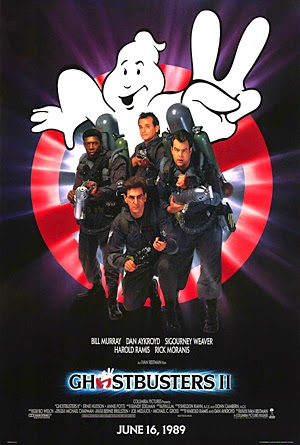
The other day I wrote about how any new Ghostbusters movie will only disappoint, and used Ghostbusters 2 as the prime example since it did so poorly in comparison to the first one.

That inspire reader Nate to comment:

Ah but the Ghostbusters did have a saturday morning cartoon show that ran for a few years. So there might be some question of why did 2 flop but the spin-off succeed? 
I think the biggest problem with 2 is that the story ended up being too much like 1, a rehash. Had they taken the story in actual new directions and allowed things to grow rather than just hit the reset button (like the relationships especially) things might have been different. 
Well that and not gone up against the juggernaut that was Batman.


Now that I had a moment to think about it, I think it went darker than a simple rehash because of one simple fact:


WALTER PECK WON


Remember Walter Peck the bureaucrat from the EPA who shut down their system, unleashing the ghosts and almost dooming the world?

Ghostbusters 1 ended with him being exposed for the know nothing power abusing popinjay he was and our heroes saving the world from Gozer.

Ghostbusters 2 opened with Peck having gotten everything he wanted. They're out of business, broke, and scattered to the four winds. They saved the world, but were unable to save themselves from bureaucracy and the legal system.

That's a dark place to start a comedy.

If they wanted to take the show in a new direction, they probably should have opened by revealing that since the defeat of Gozer supernatural activity plummeted to almost nothing, and what does happens seems harmless, if not downright tame. With no ghosts to bust they drifted apart, coasting on their brief fame, only to be thrust back together by a big, possibly ridiculous, world-threatening emergency.

Giving the win to Walter Peck was just a step too far.

A QUESTION FOR SNOWPIERCER

In case you don't know Snowpiercer is a science fiction movie with an all-star and some kind of controversy over its release, but that's not what I'm going to talk about.

What I have is a question about the premise.

The premise has humanity all but wiped out by an ice-age. The last survivors are all crammed in a train, powered by a perpetual engine, that just goes in circles through the frozen wasteland, and class warfare breaks out between the poor, stuck in the back, and the "rich" in the front over control of the dwindling supplies.

Now here's my question.

They have a source of infinite electricity, and are surrounded by the ruins of the recently fallen civilization.

Why don't they just take the resources they waste keeping the train going around and around in circles, and use it to build a more permanent, well heated, home, that's capable of growing food?

An immobile home is easier to maintain than a massive moving vehicle, a lot less moving parts, and the ability to grow food would also solve a lot of their problems involving population, hunger, and cannibalism.

Why doesn't anyone do this?

In fact the whole premise seems based not on anyone looking for solutions to problems, just looking for ways to make them worse. 

None of the motivations that form the foundation of the premise make any sense unless the creators were looking for some sort of obvious metaphor about class war that critics would mistake for deep thought. However a metaphor that reflects so little about actual reality, economics, and human behaviour is not going to have that much of a lasting effect on the zeitgeist.

Monday, 4 August 2014

Hollywood Babble On & On #1167: The Ghostbusted Conundrum


Sony/Columbia really wants Ghostbusters 3


The company has recently dropped more bombs than Curtis LeMay, many of them extremely expensive bombs, and even their "sure things" like the Spider-Man franchise now cost so much to make and market they can't break even unless they break records, and they're not breaking records.

So when presented with the possibility of reviving the box-office record breaking franchise that cost a fraction of a modern James L. Brooks rom-com and comes with literally truckloads of merchandising opportunities, they're going to go for it, hell or high water.

And there's a lot of hell and high water between the dream of a third Ghostbusters movie and actually getting it made and released.

1. Harold Ramis, the man who took Dan Aykroyd's impossible science-fiction/horror/comedy epic into the plucky underdog vs the government and the supernatural movie we all love, is dead.

2. Bill Murray isn't interested, too busy being Bill Murray as a piece of performance art.

3. Ivan Reitman isn't interested in directing, too grieved by the loss of Ramis.

4. Dan Aykroyd, though keen on the project, has been distracted for the last 20 years by building a Canadian liquor empire, and it shows in a lot of the things he's done recently.

But Sony's not going to let it go, they're even talking to Bridesmaids director Paul Feige about making a reboot with an all female cast.

Now this is where I will get called a sexist, because anyone who questions any decision about gender swapping characters is called sexist, which is about 75% of the reason behind the decision:

An all-female Ghostbusters will be a disappointment.

But wait, there's more!

An all male Ghostbusters starring the Judd Apatow  mafia of Rogen, Franco, & Co. would also be a disappointment.

A reunion of the living original cast-members would also be a disappointment.

In fact I believe that any attempt to revive Ghostbusters, no matter who does it, or how, would be a disappointment.

Don't believe me?

Then ask yourself this question:

Why do you think they didn't make Ghostbusters 3 twenty-five years ago?

Because even though fans had demanded Ghostbusters 2 since the first one premiered, it made less domestically and internationally combined than the first one made domestically, and was outshone by Batman from Warner Bros. and was written off as a flop by Columbia Pictures. It was also looked down on by the critics, currently holding a 51% "rotten" rating at Rotten Tomatoes.

Do you see what I'm getting at?

Ghostbusters 2 was a disappointment.

You see there's something I have now christened THE GHOSTBUSTED CONUNDRUM.

You get a movie, it's original, imaginative, and connects beautifully to the zeitgeist. It becomes a huge hit.

People say they want to see more!

The studio says "And you shall have more!"

Then the people get more, look at it, and say… "Oh, there's something missing I can't put my finger on… What else is playing?"

The original was not a perfect film, but it connected so well with fans, it didn't matter. However, getting that connection back for a sequel, or a reboot, is like putting toothpaste back into the tube.

Putting such a task on the back of Paul Feige and female performers like Kristen Wiig and Melissa McCarthy is setting them up to fail. The audience will look at the trailer, not feel that chill down the back of their neck that they had with the original, go see something else. Then the studio can say: "See, female-driven movies can only go so far! They're the reason why it bombed! Not us!"

Feige and company would be better off doing something original that doesn't have so much baggage strapped to it.

The audience too should learn to let go, and let the franchise rest, so that something new can be allowed to be created.

We'll all be better off that way.

Friday, 1 August 2014

Hollywood Babble On & On #1166: Random Snark Attack!

MONEY MADE / MONEY PAID:

Lionsgate made a wee miscalculation when putting together boss-man's Jon Feltheimer's compensation, announcing he was getting $63.6 million then said "Whoopsie" and corrected the amount to $66.3 million.


Apparently they left a sack of money behind his desk.


Now some will say "That's too much!" and scream about fairness, and inequality and I will have to say: Balderdash!

The only question that should come up are the same questions that should be asked when it comes to movie star salaries:

DOES THE PERSON IN QUESTION MAKE MONEY FOR THE SHAREHOLDERS?

IS THE AMOUNT BEING PAID TO THE PERSON IN QUESTION COMMENSURATE TO THE MONEY THEY'RE MAKING FOR THE SHAREHOLDERS?

If the answer to both questions is "YES" then there is no problem, no unfairness, and it isn't too much.

Now the key point is that the company's Board of Directors and the shareholders should know the answers to those questions. If they don't then neither are doing their job.

NBC GETS PANNED, SORT OF…

Following the ratings gold of Sound of Music Live, NBC is putting together another live musical, this time it's Peter Pan. In keeping with tradition of casting a woman as the boy who never grew up they cast Allison Williams of HBO's Girls in the title role.

Some are criticizing it as nepotism since her father is the anchorman for NBC Nightly News, but in fact they chose the Girls actress because they wanted to cast someone the audience has never heard of.

GYPSY: FLOGGING A DEAD HORSE

Speaking of musicals, Barbara Streisand's long stagnant remake of the musical Gypsy has come back from the dead at Universal. Streisand will direct and star as the title character's domineering stage mother Momma Rose, because Momma Rose gets all the show-stopper songs.

I wrote about this three years ago when it was going to be made at Warner Bros. and said that the project would cost way too much for the size of the audience and that Streisand wasn't as big a name as she was in the 1970s, and even then wasn't as big outside of Hollywood as she was inside Hollywood. Which is the key why this dead horse is still being flogged. Within Hollywood she's the 800 pound gorilla who gets whatever the gorilla wants.

WANNA PLAY A GAME?:

I stumbled on a picture of something while doing research and I thought we'd have a little fun with it.

I know what this object is…


…the question is DO YOU?

Can any of my readers, who I hope are fiends for obscure trivia, identify that object and tell me what it is, simply for bragging rights?