Wednesday, 9 July 2014

The Book Report: Nationalize It?

The Amazon/Hachette feud is getting dirtier.

Amazon, as you may recall, has been playing silly games with books by mega-publisher Hachette, and I also wrote about how it's just one of the troubles affecting the book business in general. Amazon's shot across the bow is a trial balloon letter where Amazon offers Hachette authors 100% of all their e-book royalties. 

Now while it may sound like Amazon is being all generous with the poor downtrodden authors, folks should beware of internet geeks bearing gifts. The big thing is that accepting that deal would no doubt violate the authors' contracts with Hachette, trapping all sides in an expensive legal quagmire that only Amazon and Hachette could possibly emerge from sans bankruptcy.

Now the brain-trust at Salon.com have offered a suggestion: Nationalize Amazon, Google, and any other internet company that displeases the author of this "think piece."

First thing I have to say is:

HAHAHAHAHAHAHAHAHAHAHAHAHAHAHAHAHAHAHAHAHAHAHAHAHAHAHAHAHAHAHAHAHAHAHAHAHA!

Okay.

Back to the topic.

Yes, the internet was invented by departments of the US government. Specifically it was created by the dreaded US Military/Industrial Complex. It's original intent was for military and government facilities to exchange information even during a nuclear attack.
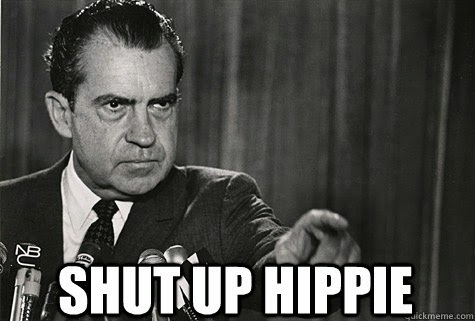
A form of the internet as we know it today was first envisioned by Richard Nixon in his little known "Wired Nation" plan.

Nixon's dream was to have a box attached to every television in the USA that allowed people to watch whatever they wanted, whenever they wanted to,  to communicated to others via TV, and to be able shop from home and deal with any retailer they wanted.

It was immediately shot down as technologically impossible, condemned as potentially "fascistic" and "Orwellian," and pretty promptly forgotten.

Now while the internet was exclusively government property it could do simple text only e-mails, and that's about it. When it expanded to connect universities it developed some more capabilities, but otherwise remained a scintilla of a shadow of what it is today.

But the computer nerds at the universities saw potential, not only for sharing data, but for making profits.

It's thanks to the profit motive that the internet went from a handful of e-mail services and buggy bulletin boards to the fever swamp of porn, self-righteous outrage, and cat videos that we all know and love today.

So while the government started the ball rolling, Nixon's dream couldn't be realized until private businesses figured out how to make that rolling ball useful to anyone outside of military bases and universities.

Now let's look at the practical aspects of nationalizing businesses.

THEY MAKE THINGS WORSE.

Need more explanation?

All right.

I'm Canadian. I grew up and live in what has been classified as a "have-not" province since the 1930s. I've seen businesses get nationalized, and I have yet to see them work.

A good example was the Sydney Steel Corporation (SYSCO) in Cape Breton, Nova Scotia. For decades, and under various names and owners, it mined local coal, processed it into coke, and then used that coke to smelt Newfie iron ore into steel, then forge that steel into rails for export.

By the mid-1960s the rail market was shrinking, the costs of mining coal was going up, and it just wasn't feasible to keep the plant going. 

But the plant was the centre of hundreds of jobs all over the region. Those people voted, and the ruling party wanted those voters voting for them, so they nationalized it. 

The steel plant and the mines stayed open. They pumped out rails they couldn't sell, and every year lost a fortune.

SYSCO then became a political football, draining millions every year from the province, and creating products they couldn't sell and lots of highly toxic pollution. 

Eventually the province ran out of other people's money and the mines and the plant closed, leaving behind the toxic Sydney Tar ponds that took over 20 years to clean up.

That's not an outlier or an anomaly in the annals of nationalization, it's pretty illustrative of the entire thing. Similar stories can be found from the USSR, to the UK, to the USA and all points in between.

Now let's look at the political aspect of nationalization. Does Salon.com really want that sort of precedent in place with the possibility of a Republican presidency coupled with a Republican majority in both houses of congress in 2016?

Would they be so keen for nationalization of internet based businesses then?

Probably not.

Now this is the point where you say: "But D, the article wanted them to be heavily regulated like a public utility rather than be taken over and run completely by the government."

Then they shouldn't have used the word "Nationalize" so much when they claim to be advocating regulation.

Let's look at how the government can regulate Amazon and Google into becoming good corporate citizens.

They can't.

Guess who writes government regulations.

Congress?

The President?

Bureaucrats?

They all take credit for writing regulations, at least the ones that don't end up a public political embarrassment, but they don't really write them.

Who writes them, then?

Lobbyists.

Lobbyists for the people the government is trying to regulate to be specific.

That means that any attempt to regulate internet commerce will be written by people like Amazon and Google, and they will be structured to protect Amazon and Google while putting the screws to any and all potential competition.

Amazon and Google are not monopolies, yet, but they they very well could be in the near future. To become monopolies they need the backing of the government, because only the government has the ability to legally arrest, fine, or confiscate material.

So what's the best way to handle Amazon if the heavy hand of the state will inevitably be turned to the service of Amazon?

Amazon needs viable competition.

Amazon almost had competition in the form of Borders Books. Borders was an early pioneer of the "big box" style bookstore, and had the most efficient inventory system in the industry. They knew what was on each shelf in each store in the country, and could move merchandise to the best locations quickly and with a minimum of fuss.

So why did Borders go out of business?

It committed suicide.

When e-commerce of books was a new thing, Borders signed its death warrant by turning its online sales wing into basically a link to the Amazon web-site. They could have set up a system where orders could come in online, and the nearest store with the item in stock could ship it, cutting down on delivery time and costs.

But they didn't, they were short sighted, the rest of the book business didn't see it either, and now they're paying the price.

The big multi-billion dollar mega-publishers should band together with the independent presses, and figure out what systems can be set up to get books to people without Amazon.

I live in a small town, and we lost our independent bookstore to Amazon, and now we're stuck with the selection at Wal-Mart and the local grocery stores which consist mainly of books either written for teenage girls, or by James Patterson.

That's not good for anyone. Not for readers, not for publishers, and not even for retailers.

First, make deals and plans with Amazon rivals like Books-a-million, Barnes & Noble, and many other to make people think of their sites when they think of shopping online.

Then there's physical stores, which the business seems to forget is an old-fashioned but highly enjoyable way to shop for books.

Sure, online is convenient, especially when you already know what you want, but then you have to wait for delivery, and there isn't the joy of the magical accidental discovery you make while browsing the shelves of something you didn't know you wanted until after you've found it.

The technology exists so that no reader should have to go to Amazon to get a book. Publishers should make sure that the new book printing Espresso machines are in every possible location, especially the smaller bookstores. They should be under a big sign that says: "If it's not on our shelves, just ask at the counter, and you can have it in ten minutes."

Use high-speed on-demand on-site printing to lure the punters in, then let the browsing time to induce them to buy other stuff on top of that. I know book readers, I am one, and they will always buy more books when given an opportunity.

If my local store had one of those machines it probably would still be in business. Why wait a week to get what you ordered when you could walk down to the local shop, give your order to the clerk, or send it in online and have it all ready and waiting for you to pick up?

Then Amazon might be willing to act more like a business, and not like a power-drunk absolute monarch.

That's what I think, tell me what you think in the comments.

Monday, 7 July 2014

Hollywood Babble On & On #1159: Random Drippings From The Brain Pan

WEEKEND WEAKENED

Overall box-office for the 4th of July weekend is down.

Not just down, but really down.


Do you think the studios will pause and take a look at what they're doing to see how such a precipitous drop could happen?

Probably not.

TRIBE GETS A DISTRIBUTOR

Drafthouse Films has acquired The Tribe, a Ukrainian film set at a school for the deaf and with a cast of all deaf amateur actors. Sadly they turned down my suggestion to retitle it "Talk To The Hand."

*pelted by rotten tomatoes*

Fine, be that way.

WEINSTEIN CO. COLLECTS LAWSUITS LIKE TRADING CARDS


A man named Michael Trigg donated $100,000 via CharityBuzz to the La Jolla Playhouse with the understanding that it would result in him getting a small part in Scary Movie 5 with a few lines.

The suit alleges further costs because he had to change his flight and accommodation plans because of changes in the shooting schedule, the film's makers didn't know about the contest, or his role, and about a dozen different troubles and complications that left him bereft and feeling that he has to sue everyone involved for unspecified damages.

Which makes me wonder why the Weinstein Co. ever did the contest in the first place. Casting is tricky, even the small parts, and characters get edited out all the time, including major ones. If everyone involved in making the movie isn't fully in-on the thing, it's going to cause confusion, dissatisfaction, and probably lawsuits.

Maybe they should have just offered a trip to the set to meet the stars. It may not have raised as much money, but it would have saved money on lawyers.

HEIGL-ANIAN DIALECTIC


Now a look at Hollywood history would reveal many actresses who made many romantic comedies, some almost exclusively so, and had pretty long and healthy careers.

Heigl's problem comes from the simple fact that too many of her romantic comedies were shit, and for some reason very few people were willing to work with her more than once.

PINK FLOYD REDUX

Legendary British rock band Pink Floyd is going to release their first album in 20 years.

It's going to be called: PIPER AT THE GATES OF DAWN WILL YOU SHUT THE HELL UP I'M TRYING TO SLEEP.

First single will be called GET OFF MY LAWN YOU DIRTY HIPPIES.

GAME OF WINE


Here are some slogans for this new wine:

LANNISTER WINE*: "By the second glass even your sister will look good."
*Available in a Tyrion size half-bottle

STARK WINE: "You'll lose your head over it."

TARGAERYAN WINE: "The Whitest of the White Wines."

Friday, 4 July 2014

YOU HAVE QUESTIONS! I PRETEND TO HAVE ANSWERS!

I put out a call for questions, and you hath delivered!

Now it's time for me to pretend that I have the answers.
Kevin Waleroup asked...
I have start my own publishing company call Blaster books but I'm now looking for Arthur can you help me?
Congrats on diving into the hairy, and sometimes scary world of book publishing. I'm assuming you're looking for "authors" and that the auto-correct on your phone took you in a different direction, because I don't know where Arthur is.

Oh, wait, there he is…

Anyway...

Let's look at what you need to be a publisher.

1. The means to produce books, which includes:

  • Authors. People to write the books, they can be found via an institution called "The Slush Pile" or through literary agents. The slush pile is the name for the pile of unsolicited manuscripts sent in by authors and agents.
  • Editors. These are the people who separate the wheat from the chaff in the slush pile. They then work with the authors to make sure that the final product reads like a professional quality novel. Key are "copy-editors" who seek out and destroy glaring spelling, grammar, and typographical errors that separate the best seller from the self-published amateurs.
  • Graphics. Nothing sinks a fledgling publisher quicker than bad cover art. There's a website dedicated to some of the eye-bleed inducing abominations that clog up self-pub and small-press outlets like Amazon. They repel book buyers with their stock image mash-ups, and they tell wannabe authors that this press is amateurish and poorly run. So decent graphics are a must.
  • Manufacturing. The means of production have simplified, especially for e-books. E-books can be made using a desktop computer. Print books are trickier, but not as hard as they used to be.
2. The means of getting books to readers:
  • Distribution. There's no point to publishing books if you don't get them to readers. E-books require a connection to a big online retailer like Amazon, iBooks, and Barnes & Noble, and are not that hard to set up. Getting print books into physical stores is most likely trickier. The big distributors want publishers who can provide a steady stream of product that will sell.
  • Promotion/Marketing. Readers need to know about your books if they are going to buy them. That means getting the word out. Social media spam can only go so-far, and that ain't far at all. Leaving paid advertisements, and word of mouth that can be amplified by good reviews by influential readers.
Hope that helps in my own small way.
what is going on at NBC now?
Well, I'm not sure what's going on right now. The age of the "personality executive" at NBC seems to over, and with the cancellation of Community, the only show I watch on NBC is the strangely compelling Hannibal.

Nate Winchester asked...
You've talked before about how revolutions are making the ability to create movies cheaper and cheaper and with distribution being practically free now... how long do you think it will be until we see a self-releasing revolution in the movie business like we've seen the self-publishing one in the book business? Do you think that might be the next indie upheaval?
We're starting to see not so much a revolution, as an evolution when it comes to what you would call "self-releasing." Outlets like Amazon and Netflix need more content than the major studios can provide for their VOD services, and digital projection makes theatrical releases more affordable.

However, it's still an expensive and time consuming proposition that most people, even filmmakers, lack the skill set to master. I'm sure that as I write this there are people out there looking for opportunities to be found in getting such material to their target audiences.
You've spoken a lot about the jobs in Hollywood, but I'm curious how those jobs interact with each other. Like when the director wants a change, do they call the writer or just do it without them? How much do the editor & director get along? Those are such examples, I'm sure there's many more but I can't think of them right now. (hey... could be a new blog topic series)

As for interaction of the different jobs that depends a lot on the film and who is making the film. Some directors are hands on from script through production, and post-production, some leave things to the experts, while others are hands on when they should be leaving things to the experts. 

There are literally reams of union regulations that say who can do what in a major Hollywood production, but mostly they centre around who gets credit for the work, which determines royalties and residuals.
I know you don't like predicting the academy awards, but what about the razzies? 
Ever thought about doing your own awards?
The Razzies are even more predictable than the Oscars. Pick a movie that teens are into, but is otherwise nonsense, and shower it with questionable prizes.

As for my own awards. Too much work, too little point.

I see on this:
The words:
"A wickedly satirical..."
That and your previous post on satire makes me wonder... D what do you think are the best and worst satires out there? And (if "worst" doesn't cover it), what do you think is the satire that most missed the subject it was aiming for?

The best satires are the ones that don't hit you as a satire right away. Instead of hammering you with their ideas they use humour to slyly let the point they're trying to make seep into your mind.

Right now I'm re-watching the original British production of House of Cards and on the surface it's a melodrama about a ruthless man doing whatever it takes to reach the top of the proverbial greasy pole including murder. Beneath that it's a wicked satire of politics, politicians, and the media based on a surprisingly conservative political philosophy.

You see: satire built on a liberal philosophy say that all the problems with the world are people who have the wrong ideology. Those who follow that wrong ideology, like corporations, religious groups, and the like, are inherently stupid, evil and often grotesque because they follow that ideology, and thus should be mocked for their desire to remake the world in their stupid, evil, and grotesque image.

Satire built on a conservative philosophy is all about the temptations power offers to people, who are all fundamentally flawed because they are human beings. The greater the power on offer, the greater the flaws become as the wrong people are attracted to it. Which can be summed up as: "Shit floats."

Judging whether a satire is good or bad depends on what you believe and the judgement of time. Good satire, while commenting on the time it was made, is essentially timeless, because no matter how many things change, some fundamental truths will always apply. Bad satire comes across as shrill, lecturing, and in the long run extremely dated. 
 rick mcginnis asked...
On the topic of a movie producing revolution - I've noticed that the imdb trailer page frequently posts trailers for small-budget films, which are given the same space as new releases as big studio or pseudo-indie films. So far, so good. The other thing I've noticed is how awful the trailers are, and how well they dissuade me from any curiosity about the films they tease. If you work from the rule that a trailer usually features the best bits of any film, they work as negative advertising. It's nice to hope that, with production costs falling and distribution networks being given an end-run, a whole bunch of talent that had fallen through the cracks would emerge, but that doesn't seem to be the case.
Remember Sturgeon's Law: "90% of everything is crap."

That law is probably getting an extra boost from the simple fact that while the ability to make films has been democratized, the talent to make good films hasn't.

However, the market has ways to correct this, all but a few of the really bad filmmakers will eventually either run out of money, go on to have big studio deals, or realize they suck and move on.

Eventually, as this new form of micro-budget uber-indie filmmaking matures, the static-noise of shit will begin to fade and you'll start to see real talents emerge and find their audience.

90% will still be crap, but at least the trailers will look more professional.
Kevin Waleroup asked...What was your science fiction book about?
You mean JOE AVERAGE the e-book that I'm giving away for free until Saturday July 5th 2014?

It's about a man with superhuman powers, but a less than superhuman appearance. He's an average looking schlub who just happens to be able to fly, deflect bullets and punch his way through brick walls.

He tries to use his powers for good, but ends up dealing with not only with super-villainy, but the even nastier everyday villainy of crooked politicians, their cronies, and a media that doesn't know what to do with a hero who doesn't look like he should be a hero.

Why don't you get a copy, you can't beat the price.
Anyway, I hope I've answered all of your questions as well as I could.

Thursday, 3 July 2014

Hollywood Babble On & On #1158: Nocus Pocus… Maybe… Maybe Not?

Tina Fey caused a bit of a stir on social media when a rumour got out that she was going to make a sequel to the 90s Disney film Hocus-Pocus. Turns out, the rumour was wrong, she is working on a witch related project in the vein of Ghostbusters at Disney, but it has no connection to the 1993 movie.


At least not yet.

But cold calculating Hollywood might change that.

The original Hocus Pocus came and went in theatres without making much of a stir, earning about $39 million domestic, but had a popular afterlife as an annual Halloween feature on Disney's cable empire and home video.

Now this is where a sequel might come about.

Disney sees all the nostalgia from the Gen-Ys and the Millennials and think "Oh, there's some interest in that old chestnut."

Then they look at what Tina Fey is working on, then they look at Tina Fey's somewhat lacklustre box office record, and then the ratings she got on 30 Rock, and think "Oh crap, we're investing a lot of money in this project to an actor who, outside of one bit of voice work, cannot crack $100 million in ticket sales and can be a bit of a dead weight with the audience. Even the last Muppet movie sank like a stone after we put her in all the ads."

You see Fey's problem is that she's what I call a "Media Appealer." Her core audience is not the average Joe and Jane who watch TV and buy movie tickets. Instead her biggest fans are people inside the business we call "show."

They can shower her with critical praise, awards, plum roles, big money deals, and keep shows running for 7 seasons while never getting out of the bottom 10 in the ratings, but they can't put bums in seats willing to watch something with her name on it.

Now while the folks at Disney are part of Fey's insider fan-base, they are probably not stupid. Realizing the nature of Fey's "stardom" they might start thinking: "Hmmm. What if her witch-movie was the Hocus Pocus sequel those wacky kids seem to want?"

Then will come demands to re-write the film, finding affordable replacements for Bette Midler, Kathy Najimy, and Sarah Jessica Parker, which will probably mean hiring them again, and hoping to foist it on audiences by Halloween.

If Tina fights it, then Disney just drops her project and gets someone else to do the one they want. That's the beauty of being a big studio, there's always someone else to do it.

So Fey's best bet would be to try to ride it, and hope that it's a hit, then she might be able to claim an audience outside of Hollywood and the critics and keep her career going just a little bit longer.


Monday, 30 June 2014

ASK ME ANYTHING!

Time for another Q&A blog.

So if you have a question about ANYTHING to do with pop culture and the business behind it, leave it in the comments, and, depending on the response, I will post the answers on Friday or Monday.

NOW ASK ME ANYTHING!

Friday, 27 June 2014

Hollywood Babble On & On #1157: CBC Does Canada, Lohan Does Mamet!

NIGHT OF THE LONG KNIVES IN TORONTO


The venerable and long tumefied Canadian Broadcasting Company, Canada's taxpayer & commercially supported national broadcaster announced that they will trim their staff by 20% by 2020.


Now this will be played in one of two ways.

The most sensible way to handle these reductions through simple demographic attrition. That means that a lot of in-front-of and behind-the-scenes people that have been working in senior high-paying jobs in CBC's Toronto HQ since the government of Prime Minister Lester B. Pearson would retire and collect their pensions.

However, that sensible way is also the most unlikely way.

The CBC and its employees have a rather unique status. It's considered not only a bureaucratic position, promising lifetime employment & benefits, but also the centre of Toronto's elite society as well as what passes for celebrity in Canada.

That means that some people get branded as "institutions" and stay around long past their sell-by date. Every show, whether drama, news, or general entertainment have to involve the same mostly Toronto-based troupe of actors, journalists, and performers. A classic story was when CBC inked a deal for a Canadian franchise of Antiques Roadshow. They announced that they were looking for a young, hip, and previously unknown host for it. They ended up hiring a fifty-something host who has worked for the CBC off-and-on for the previous 25 years.

So here is what's going to happen.

The CBC will not use retirements and sensible fat-trimming in the executive suite to make these cuts. Instead they will lay off the younger, popular on-air personalities, arbitrarily cancel shows that people actually watch, and find other ways to punish the audience. All the while saying through their allies: "Don't blame us, blame the evil Tory government that we actively campaign against who won't give us unlimited money."

This is explained by something called "Public Choice Theory," or as I like to call it, PCT.

PCT explains that people in government, politicians and bureaucrats, are still human beings despite their claims of working for "the public good."

That means they spend most of their time catering to the special interests that will protect, promote and extend their own personal fiefdoms, whether that does anything for the public they're supposed to serve or not.

LINDSAY'S NEW BEGINNING ON THE WEST END?

Actress and professional club-hopping train-wreck Lindsay Lohan has been cast in a West-End production of David Mamet's 1988 play Speed The Plow.

Now it seems an odd choice since, unlike movies, TV shows, or fashion shoots, a live play can't really tolerate someone who is prone to show up 11 hours late if she shows up at all. In fact, movies and TV can't tolerate that behaviour for very long, since, as Einstein discovered: time is money, which is why she's considered unemployable.

However there are up-sides to this casting:

1. PUBLICITY: People on both sides of the Atlantic are talking about a non-musical production in London. Which is probably why the producers cast her. Schadenfreude is a great ticket mover.

2. OPPORTUNITY: Lohan's understudy will most likely get lots of stage time and media exposure.

So, barring Lohan burning down the theatre and all inside it, this stunt is not much of a gamble for the producers, more of a scam, but not a gamble.

__________________

Speaking of literacy: My e-novella MINDER is available from Amazon for 99 cents.

Wednesday, 25 June 2014

The Book Report: The Big Book Crisis?

Reader Nate Winchester likes to nudge me with topics, the other day it was my piece on satire, and then he dropped a couple of links in my inbox about the publishing business.


Now I don't write about about the business of books very often, the last time I wrote about the feud between mega-publisher Hachette and mega-retailer Amazon, and that's feud is the topic of the first link, a discussion between popular authors J.A. Konrath and Barry Eisler. The second link was author Sarah A. Hoyt taking a look at what she considers a fundamentally flawed business model.

I suggest reading both posts and then come back here for my thoughts.

I'll wait.


.


.


.


.


.


.


.


.


.


.


.


.


.

.


.


.


.


.


.


.


.


Okay.

Read them?

Good.

Now let's talk the book business.

I'm on that hamster-wheel-made-of-psychological-razors called being an author looking for a publisher. During my quest I've accumulated many rejections, but I've also encountered many wonderful people who work in the publishing business, but among the many diamond I've also had a few really abysmal experiences at the hands of the publishing industry.

One was a now-former agent who sent an instant auto-reply rejection letter to a personal e-mail that he asked me to send him.

Then there was a science fiction publisher, who regularly brags about how well they treat new authors, whose rep claimed that my book had been highly recommended and was being carefully considered at the top levels of the company, only to get a rejection letter from a bottom rung slush pile reader after 6 years and 11 months of chain jerking.

It's not just the unpublished losers like me who get this sort of treatment. A famous story was told by Stephen King. After the release of Carrie the prolific author's books were breaking sales records worldwide and he was his publisher's biggest seller probably of all time. Despite that his editor had to re-introduce him to the company's grand poobah's at every meeting because the people running the company literally had no idea who he was or what he did.

King soon went to another publisher as soon as he legally could. However, even that relationship eventually soured, and King is now with a third publisher, still churning out best-sellers.

Now these and hundreds of other stories show that the publishing industry, whether totally doomed or not, is in an unhealthy, dysfunctional state.

Let's look at some of the problems that I've seen, and let's not forget I'm not an expert and if I'm making a mistake let me know:

1. Retailer Woes: If the publishers are having trouble with Amazon, it's because they took the path of least resistance and allowed Amazon to crush or swallow any competition. The publishers could have fostered better relations with potential rivals like Borders and Barnes & Noble, embraced new technology, and made it easier for independent bookstores to obtain special orders as fast as Amazon, but they didn't. Now they have a leviathan at their door wanting more and more, and they don't know what to do with it.

2. Best-Sellers?: Know what it takes to make the New York Times Bestseller List?

The fact is, no one outside of the NYT is supposed to know because how the list is put together IS A SECRET.

The Times says that their methodology is kept secret to keep people from "gaming the system." However, using the same algorithms and metrics for the past few decades probably means that someone, somewhere in publishing has figured it out, and knows full well how to play it like a violin. 

Which means that we have no way of accurately knowing how many individuals are buying what, and e-books, whose sales should also be easy to tally are also buried under obscure metrics.

Basically those more knowledgable than me are saying that bestseller lists are inaccurate and easily manipulated. That's not healthy.

3. Advances or Setbacks?: We all hear about how celebrities of varying degrees of fame and/or talent getting huge advances to "write" everything from their memoirs, to fiction, to fiction masquerading as memoirs.

What we don't hear is just how many of these advances pay off.

For those who don't get the jargon, an "advance" is a payment a publisher gives an author that's put against future sales of the book in question. If the book makes more money than what was paid in advance the author then qualifies for royalty payments based on sales. Royalties from a major "legacy" publisher are usually between 10-15% of the book's cover price.

Now lots of famous people get huge advances for books and I'll bet dinars to donuts that the majority of them don't pay off at all. Come on, who honestly believes fans of Snooki or the lesser Kardashians really buy any books, let alone theirs?

This comes at a time when major publishers have slashed their "mid-list" of commercially viable but not NYT qualifying books by about 90%.

How many mid-list books could have been bumped into more mainstream success with the resources wasted on a tell-all by someone no-one wants to hear from?

4. Selection: As I just mentioned the major publishers have slashed and burned their mid-lists. This means that thousands of books and hundreds of authors were dropped off into oblivion.

Now I had known that the mid-lists were being metaphorically massacred, but until recently I didn't know how far the slaughter had gone.

Then it got me thinking about the last time I bought a new book. I'm too poor for hardcover prices, but I quickly realized that outside of a tiny team of authors, I haven't bought new fiction in ages. If it's nonfiction that I need for research, or it's about a topic, like film & business, that I'm interested in, I will save up to get it. As for fiction, I usually just stock up on a lot of dead authors I find at the annual library sale, or in second-hand bookshops.

Why do I do that?

Because I find too much new fiction is too much alike. Too many, in every genre, are trying to hard to be the other book that just came out, but bigger, and if you want something out of that mould, you're better off looking into the past for some variety.

I don't really see the situation getting any better since those who are supposed to be in control of the industry don't appear to see a problem on their side of the equation.

Now I'm perfectly willing to admit that I don't know the whole story here. There are things I am probably not seeing, and I'd love to have someone in the industry explain how everything's just fine.

If you have any thoughts of your own, please let  me know in the comments.


_______________________